Why You Should Walk for at Least 10 Minutes After Dinner
Last updated November 2026
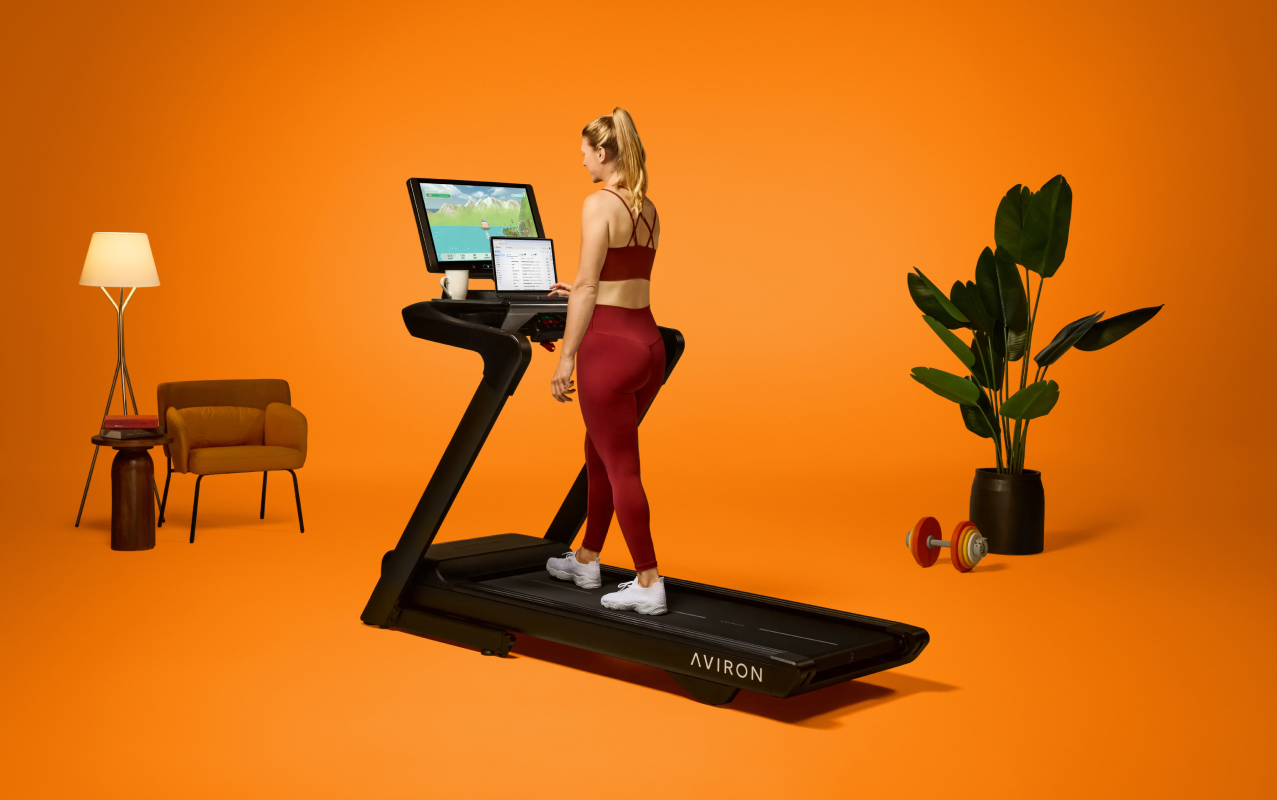
Short answer: A 10-minute walk after dinner shrinks the blood sugar spike that follows your biggest meal and helps food leave your stomach faster. In a study of adults with type 2 diabetes, 10 minutes after each meal beat one 30-minute walk a day, and the gap was widest after dinner. Start within about 30 minutes of eating and keep the pace easy.
Your grandparents probably had a saying for this. In English it's "After dinner rest a while, after supper walk a mile." German has a single word for it, Verdauungsspaziergang, the digestion walk. A Chinese proverb promises that a hundred steps after a meal will see you to 99.
The old advice holds up. In 2023, German researchers pooled the trials on exercise and meal timing and put the English proverb in their paper's title. Their verdict: walking after eating blunts the blood sugar spike better than walking before, and the sooner you go, the bigger the payoff.
The catch in November is that "after dinner" usually means dark and cold outside, which is a good argument for doing the walk indoors.
In this article
- What happens in your body when you walk after dinner?
- What does the research say about walking after eating?
- How long should you walk after eating?
- When should you start, and how fast should you go?
- Are there side effects of walking after dinner?
- What if it's dark, cold or raining after dinner?
- How do you make an after-dinner walk a habit?
- FAQ
What Happens in Your Body When You Walk After Dinner?
Two things, mainly:
- Your blood sugar spike gets smaller. The carbs in your dinner become glucose that floods your bloodstream over the next couple of hours. Working leg muscles burn glucose for fuel and can pull it out of your blood with less help from insulin, so less of it piles up.
- Your stomach empties faster. In a small 2008 study, a slow treadmill walk after a big meal cut the time it took the stomach to empty halfway from 123 minutes to 107. Brandy, herbal liqueur and espresso, the classic after-dinner "digestifs," did nothing. So much for the nightcap.
In that study, though, walking didn't change how full or bloated people felt, so don't count on it to fix that too-full feeling.
Why dinner in particular? For most people it's the biggest, carb-heaviest meal of the day, and it's followed by the longest stretch of sitting: couch, screen, bed. The New Zealand team behind the first study below gave exactly that reason for why walks after dinner had the biggest effect.
What Does the Research Say About Walking After Eating?
Most of the evidence comes from people with or at risk of type 2 diabetes, because they have the most to gain. Six studies cover most of it:
| Study | What people did | What happened |
|---|---|---|
| Reynolds 2016, New Zealand | 41 adults with type 2 diabetes, two weeks each: a 10-minute walk after every main meal vs one 30-minute walk a day | Post-meal blood sugar was 12% lower overall with the after-meal walks, and 22% lower after dinner |
| DiPietro 2013, older adults | 10 inactive adults aged 60+ with borderline-high fasting blood sugar: three 15-minute treadmill walks after meals vs one 45-minute walk | The after-meal walks did a better job of lowering blood sugar in the 3 hours after dinner |
| Colberg 2009, before vs after dinner | 12 adults with type 2 diabetes: 20 minutes of treadmill walking just before dinner vs 15 to 20 minutes after it | Blood sugar was lower at the end of the after-dinner walk; the 4-hour totals weren't significantly different |
| Engeroff 2023, meta-analysis | 8 trials, 116 people with and without type 2 diabetes, exercising before vs after meals | After-meal exercise beat both pre-meal exercise and no exercise; the shorter the gap after eating, the bigger the effect |
| Buffey 2022, meta-analysis | 7 trials that broke up long periods of sitting with light walking or standing | Light walking lowered post-meal glucose and insulin compared with sitting, and did more than standing |
| Franke 2008, digestion | 10 healthy men after a 576-calorie meal: a slow treadmill walk (about 2.5 mph) vs brandy, liqueur, espresso or water | Walking cut the stomach's half-emptying time from 123 to 107 minutes; the drinks made no difference |
Most of these studies are small, so read the percentages as a guide. People with normal blood sugar have smaller spikes to start with, but the 2023 meta-analysis included them, and walking after the meal still came out ahead.
Look at the second, third and last rows, too: those people did their walking on a treadmill, which is handy once the evenings get dark.
How Long Should You Walk After Eating?
At least 10 minutes. That's the dose with the strongest evidence: in the New Zealand study, 10 minutes after each meal beat a daily 30-minute walk taken whenever people liked. Fifteen minutes after meals also worked for the older adults, and 20 minutes after dinner worked for people with type 2 diabetes.
Ten minutes is also short enough that "I don't have time" stops being true. If you can only manage one meal a day, make it dinner.
The 10-minute after-dinner walk · any treadmill or sidewalk
- Minutes 0 to 2: easy stroll, about 2 mph, flat
- Minutes 2 to 8: comfortable walk, 2.5 to 3 mph, 0 to 2% incline. You should be able to talk in full sentences
- Minutes 8 to 10: ease back to about 2 mph and let your breathing settle
Feeling good at minute 10? Keep going; 20 or 30 minutes is fine too. On days you want a longer, steeper walk, try the 12-3-30 workout.
When Should You Start Walking After Eating, and How Fast?
Start within about 30 minutes of finishing your meal. In these studies, walks started anywhere from right after eating to 15 or 20 minutes later, and the 2023 meta-analysis found that the shorter the gap, the bigger the effect. If walking straight from the table feels uncomfortable, clear the table first. You'll get credit for that too.
Keep it easy. Every study here used light or moderate walking: a self-chosen pace, about 3 METs, or a slow 2.5 mph. Think 3 or 4 out of 10 on effort. You don't need to sweat through your dinner clothes.
Is it better to walk before or after eating? For blood sugar, after. In the 2023 meta-analysis, walking after a meal lowered the spike compared with walking before it and with not walking at all. Walking before the meal made no meaningful difference to the spike. A pre-dinner walk is still good exercise; it just doesn't shrink the spike.
Are There Side Effects of Walking After Dinner?
For most people, no, as long as it's a walk and not a sprint. Side stitches are mostly a running problem, and a 2015 review found they get worse on a full stomach. A few common-sense rules:
- Keep the pace conversational.
- After a very big meal, give it 10 to 15 minutes before you start.
- If you take insulin or another medication that lowers blood sugar, ask your doctor about timing, since walking lowers blood sugar too.
- If walking after meals brings on pain or heartburn, stop and check with your doctor.
This is general information, not medical advice.
What If It's Dark, Cold or Raining After Dinner?
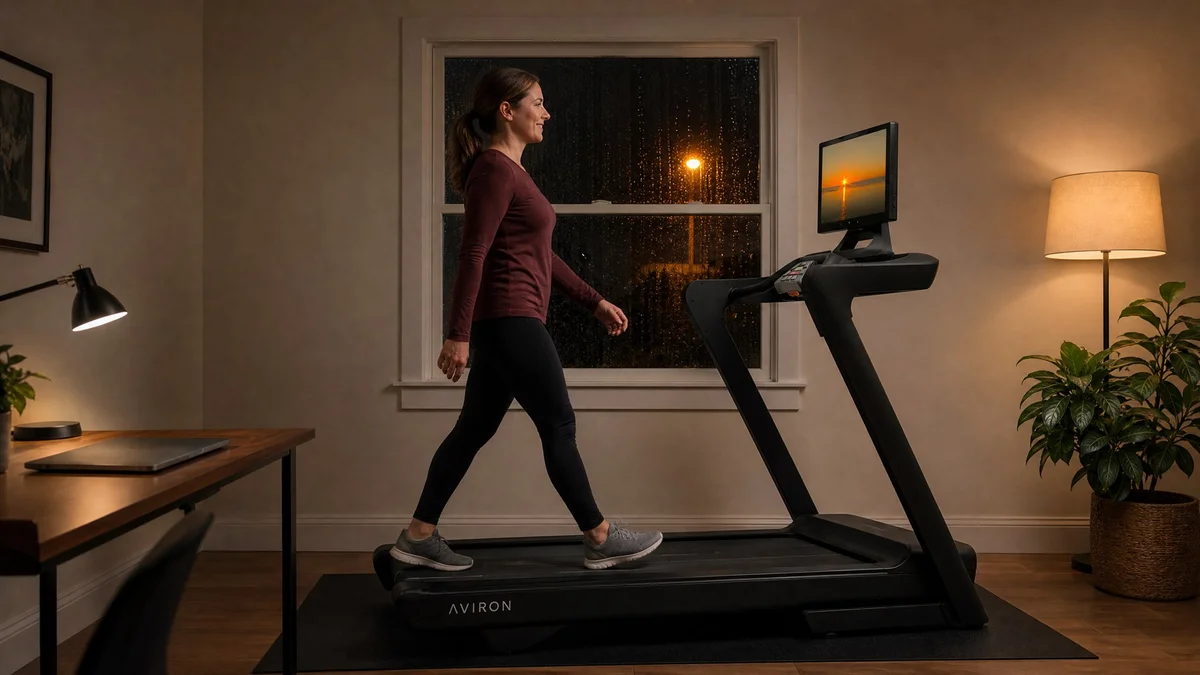
This is where most after-dinner walks die. By mid-November the sun sets before 5 pm in New York, Chicago, Denver and Los Angeles. By the time the dishes are done, it's dark, it's cold, and the couch is right there.
A treadmill takes the weather out of the decision. Three of the six studies above had people walk on one, so 10 minutes on the belt does the same job as 10 minutes around the block.
For after dinner, you want one quiet enough to use with the kids asleep upstairs. Aviron treadmills run at about 40 dB at walking speeds, about the background noise of a typical home. It also needs to live somewhere warm that you pass every evening, like a den, a spare room or a corner of the living room, because a treadmill in a cold garage is a treadmill you'll skip. The Justice folds upright with one hand, so it can share a room you already use. And one Family Membership covers unlimited profiles (kids 10 and up can use it with adult supervision), so the whole house can take turns while the dishwasher runs.
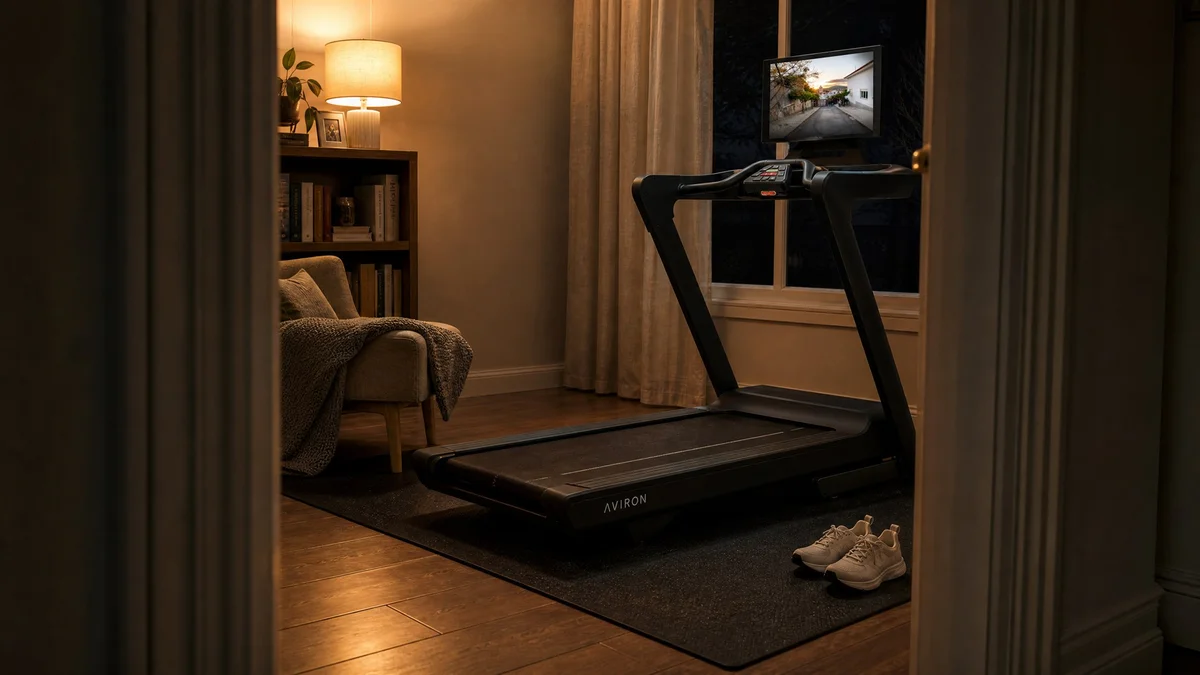

About 40 dB at walking speeds, up to 15% incline when you want more, and a deck that folds upright with one hand once the walk is done.
Shopping for one? Our guide to the best treadmill for walking covers what to check, and these fall and winter routine tips help with the rest of the season.
How Do You Make an After-Dinner Walk a Habit?
Dinner makes a great cue: it happens every day at roughly the same time, and it has a clear ending. Chain the walk to that ending (plates in the sink, shoes on, walk) and you skip the nightly debate about whether to bother.
Keep your sneakers next to the treadmill, and the treadmill where you can see it from the table. Bring company when you can: walk with your partner, take turns with the kids, or call your mom while you walk. Then make the walk something you look forward to, which is where most treadmills fall down.
A belt and a clock counting up is how a treadmill becomes an expensive clothes rack by month two. That's the motivation cliff, and it isn't a willpower problem. The treadmill was built to be boring, and your phone was built to be hard to put down.
Aviron builds that same game psychology (streaks, progress and rewards) into every workout on Justice, Podium and Summit. For after dinner, try:
- Sunset scenic walks: stroll the cobbled streets of Paderne, Portugal as the sun sets behind the village church, or try Beach Sunset or The Corniche in Oman.
- Mindful Walking: Jared's six-part series on posture, breathwork and body awareness, and a good way to wind down.
- Your own shows: streaming apps like Netflix, YouTube and Disney+ run on the screen, so one episode equals one walk.
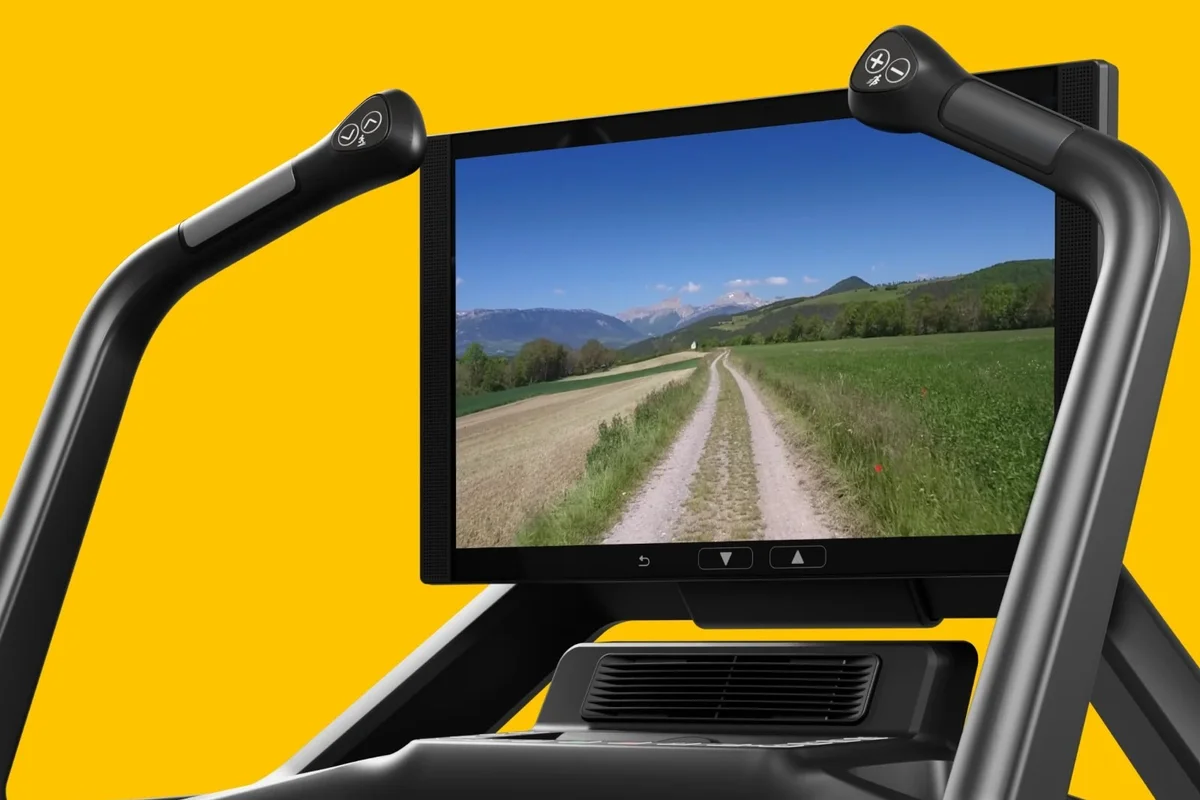
Workouts that pull you back are a big part of why 92% of Aviron members are still working out a year later. Browse the full menu in Aviron World, or compare the machines in Justice vs Podium vs Summit.

Incline from -6% to 42% on a 22 x 61-inch deck, with incline and speed keys built into the hiking handles. Flat and easy after dinner, steep when you're ready.
Frequently Asked Questions
Is it good to walk after eating?
Yes, for most people. A light walk after a meal lowers the blood sugar spike that follows it and helps your stomach empty faster. Keep the pace easy and start within about 30 minutes of eating.
Is 10 minutes of walking after dinner enough?
Yes. It's the dose with the strongest evidence. In a study of 41 adults with type 2 diabetes, a 10-minute walk after each main meal lowered post-meal blood sugar by 12% overall and 22% after dinner, compared with one 30-minute walk a day. Walking longer is fine too.
Does walking after dinner help you lose weight?
It adds activity to your day, which helps, but don't expect miracles from 10 minutes. The weight-loss paper that turns up in a lot of searches on this topic followed two people: the author and one volunteer. The strongest evidence for post-meal walks is for blood sugar, not weight.
Can I walk on a treadmill instead of outside?
Yes. Three of the six studies in this article had people walk on a treadmill. The timing and the easy pace are what count. A treadmill also means the walk still happens when it's dark or raining.
What is it called when you walk after dinner?
Researchers call it postprandial walking. Germans call it a Verdauungsspaziergang, or digestion walk. The English proverb says "after supper walk a mile." TikTok has a less polite name for it, which we'll let you look up yourself.
The Justice is quiet enough for bedtime, folds away when you're done, and comes loaded with sunset walks, coached classes and your favorite shows.
See the Justice →Or compare all three Aviron treadmills
30-day risk-free home trial · Free shipping · Financing available · HSA/FSA eligible


